


“In a world in which our lives are increasingly digital and borderless, the bureaucratic institutions of the state have been left behind, incapable of providing a peaceful order. The Westphalian system that birthed the nation state is struggling to keep up with a multi-polar, interconnected world. In this paradigm shift, the supra-national global elite is cannibalising its citizens and the fiat monetary system is collapsing in real time.”
-Logos: A Declaration of Independence in Cyberspace, by Jarrad Hope
“If you wish to converse with me, define your terms.”
-Voltaire
We are experiencing a renaissance of the parallel polis, a reshuffling of our governance structures to provide new living conditions for everyone. These parallel poleis (plural and pronounced pole-ice) manifest digitally and physically, often in both forms. Some exist permanently; others are achieved and gone instantly, like a Zuzalu pop-up village. They are also fluid and dynamic. The problem is that they are inadequately defined and misunderstood. Even “parallel polis” may be unclear for innovators and governance architects working within the industry.
Further complicating matters, entrepreneurs invent names for these social orders every time they deploy a new one. They now have many names and represent a broad array of ideas. Their names often correlate with a specific idea, goal, or philosophy. They include network states, parallel societies, startup societies, internet-native nations, cloud communities, virtual territories, virtual states, temporary autonomous zones, public-good communities, and popup cities, on and on ad infinitum. However, most social orders represent the same or similar thing but with different terminology.
This article aims to demystify the “parallel polis” and establish it as the container for encapsulating the vast range of emergent social orders. This discussion is not merely a masturbatory fixation on semantics. Our aim is to explore the history of how we arrived at the movement for parallel poleis, clarify terminology, define them, and identify what ideologies and values they represent to their communities.
Without a compass and map to describe the current phenomenon, we would be lost in an endless labyrinth of innovation and creative complexity. The map is not the territory—and as we shall see, that phrase becomes more palpable when dealing with social mutations linked to the internet and the budding age of the “global village,” as Marshall McLuhan so lovingly put it.
Let us begin by exploring the current social order and recent upheaval in how people view work, life, and nations.
Declination and Resignation
Most people can tell you that they live in nation-states; they know they live in a specific state, zone, or city associated with that nation. They often share some of the values, culture, and customs. However, under the current paradigm, people are coerced into abiding by their nation’s values and rules.
This “monoculture” upholds and enforces an allegedly inviolable social contract that determines the rules its citizens must respect on the threat of punishment. As a result, more people have become skeptical of the nation-state. They question their allegiance to it. They ask whether it will endure. With evidence from analyzing hyperinflation, mass warfare, and arms races worldwide, one can surmise that modern states are in decline.
Along with this overwhelming skepticism of nation-states, people have become more nomadic and less localized. They travel and live in temporary housing more. Hostels, Airbnb rentals, and hotels frequently comprise their living space. In this sense, locals have become global. This trend further intensified during the COVID-19 pandemic, which created “The Great Resignation” phenomenon.
The Great Resignation was a worker-led exodus from traditional 9-5 office employment, likely resulting from quarantine rules established by most countries during the pandemic. After the COVID-19 lockdowns ended, people did not exactly long to return to their regular jobs or routines. They realized they could live and work remotely from anywhere. Recent statistics suggest that “Between April 2021 through April 2022, 71.6 million people separated from their jobs, which averaged 3.98 million people quitting each month.”
Undoubtedly, people started to become skeptical of all conventional living arrangements. Some may have migrated quasi-permanently to other provinces, and other entrepreneurs even relocated their businesses entirely—an idea called “human capital flight.” When people question their living conditions or deem them unsatisfactory, they may leave those jurisdictions, “draining” their prior homeland of precious human ingenuity. Thus, we live in a world frequently reordered and reframed politically, geographically, and cognitively.

What is the Parallel Polis?
We are experiencing a reboot of what Czech dissident Václav Benda called the “Parallel Polis.” Benda was an activist during the “Velvet Revolution” in Czechoslovakia, a peaceful transition of power in 1989 when the communist party relinquished control and authority.
In his 1978 short essay “Samizdat,” also called “Parallel Polis,” Benda argues that an “independent society” is needed to resist totalitarian regimes and their censorship apparatus. “Samizdat” is the Czech term for “the clandestine copying and distribution of literature originally banned by the state.” The parallel polis, therefore, developed a culture of resistance and defiance within the Czech state.
Specifically, it operated parallel to the communist party, and the citizens involved would align with diametrically opposite or orthogonal values. Benda defined the goals of the parallel polis succinctly:
“The objective of the parallel polis is not confrontation with the power structure, but the creation of an independent society, which is nevertheless public, where free life may be lived regardless of the state’s control.”
Thus, the people enmeshed in the parallel polis and the Velvet Revolution were inherently nonviolent and peaceful. They believed in nonviolent culture and resistance. They essentially practiced a form of what Gandhi called Satyagraha, or “truth force.” The goal of “truth force” is to engage in an actionable form of civil disobedience. Of course, the dissidents in Czechoslovakia used the independent society or parallel polis as their springboard for social change.
Features of Parallel Poleis
The modern parallel polis movement shares many features and characteristics with the original idea. Most people refer to erecting new communities and bringing value-aligned people together on the land as “network states.” Balaji Srinivasan coined that phrase, and it is currently the most popular. However, the network state is only one version or vision of the parallel polis. We will discuss Srinivasan’s specific vision shortly.
The “parallel polis” idea, as described and implemented by Benda, is powerful because it worked. His activism and use of the parallel polis or “independent society” sapped power from legacy governance structures in Czechoslovakia, and he and his followers did this peacefully. In this sense, the idea represents a potent umbrella term for describing the social paradigm shift because it has undeniable historical precedence for unleashing change.
With that said, the modern movement to develop parallel poleis has many nuances. They typically share 3 features:
Independent Society: Even if they fail to admit it in their marketing literature, most parallel poleis seek to interdict traditional or legacy systems. They are communities that coalesced to build an “independent society” where they can craft their own governance, culture, and values. They did not emerge as a just-so story. Building these communities requires tremendous capital, time, and energy. They are purposeful and typically involve a form of activism against orthodox power centers. Furthermore, Benda argued that people who suffer oppression require the “space” to become fully human, build, live, and love without interference. This activism-driven component of modern parallel poleis is frequently understated and hidden strategically by founders if they do not want to incite the ire of authoritarian regimes. In this vein, some may even seek support from a host country and attempt to gain diplomatic recognition to survive and thrive.
Digital-First, Values-First: Emergent parallel poleis initially form as online communities or as contributors to a blockchain ecosystem. These groups usually align on underlying values or guiding principles. Their values can be singular in nature, such as Vitalia’s focus on biotech development and human longevity — an idea Srinivasan called the “one commandment.” It should be noted that some parallel poleis could choose not to acquire land and strictly maintain a governance model in cyberspace. See the intentions of the Logos organization for more information on that strategic trajectory. A similar idea was also articulated by the panarchists in the late 1800s. They advocated for choice in governance regardless of where they are living physically. This belief is expressed as the philosophy of “nonterritorial exit.” Note also that digital-first, as Srinivasan states, does not mean land never. These digital-first societies can choose to manifest physically in meatspace, or they can opt to maintain a digital-only existence.
Experimental Governance: These poleis experiment with their own implementations of idiosyncratic governance. This experimentation can happen legally or extralegally, depending upon their circumstances, values, and geographical location. However, since each parallel polis adopts certain values, their culture will typically inform their governance. Types of governance can include democracy, benevolent dictatorship, anarcho-capitalism, anarcho-communism, panarchism, opt-in tyranny, and mashups of all of the above. It should be noted that host countries and investors may inform some aspects of their functioning, especially regarding “criminal codes or law,” but this could change once parallel poleis gain more sovereignty and autonomy. One key characteristic of all these governance modalities is that they keep exit and switching costs low. Therefore, people can easily move between poleis without restrictions other than their contractual obligations.
These features of the parallel polis necessitate a renaissance of the idea. With so many people leaving their homes and experimenting with new governance structures, we can only expect a Cambrian explosion of differing, unique, and novel societies. The parallel poleis can also vary in size. They can be as large as a country or state or as small as a city. They can also be massive or tiny, existing solely in the cloud.
Let us now explore a few that have recently emerged.

Classification of Parallel Poleis
Underneath the parallel polis are many discrete social orders that establish values, identities, cultures, politics, and goals. However, it must be restated that these social forms fall directly under the container and rubric of the parallel polis. They all exist parallel to legacy nations but do not seek to challenge the old regime. They only vie to build “independent societies” to allow human thought and spirit to flourish. We will briefly classify and define a few of them.
Network State: One of the most popular parallel poleis is the network state; entrepreneur and investor Balaji Srinivasan laid out the vision. His idea indicates that a value-aligned community coheres online and can manifest later in a physical space or territory. Srinivasan referred to members or citizens of network states as “netizens.”
In his book, he defined the idea:
“A network state is a highly aligned online community with a capacity for collective action that crowdfunds territory around the world and eventually gains diplomatic recognition from pre-existing states.”
Srinivasan launched his V1 implementation of the network state idea as the “Network School” near Singapore. The network school aims to spin up and bootstrap network states. These new network states and their founding members will determine the governance model they will deploy. In this sense, the governance of network states is de facto experimental and evolutionary, often determined by its founder and community.
Another name for a network state is an “internet-first nation” — like Praxis — but they may or may not adopt the minutia or specifics of Srinivasan’s vision. Other names for network states include “cloud community” or “public-good community.”Startup Society/country/city/community: A startup society is an internet-first community experimenting with new territorial governance and organization structures. These societies congregate online in forums, chat groups, and value-aligned ecosystems. They frequently start with a “founder” and a core team, who build online and transition to the ground. However, a key to these poleis is that they plan their growth and development after Eric Ries’ pioneering work in the startup world. In his book, “The Lean Startup,” he argues that tech companies should model themselves after Toyota, which originated a “lean manufacturing model.” This framework emphasizes iterative feedback processes and eliminating waste to streamline workflows. In the context of startup societies, they construct their growth trajectory like a tech company, using an iterative process of citizen feedback to mature their communities and innovate rapidly.
One example of a startup city is Prospera. Their webpage describes it as a “startup city with a regulatory system designed for entrepreneurs to build better, cheaper, and faster than anywhere else in the world.” The goal of Prospera as a parallel polis is to create an independent society for entrepreneurs to build quickly without dealing with an onerous regulatory regime.
Notably, startup cities are scaled-down versions of “startup societies.” The idea is inherently the same, except a startup society starts small and can grow as large as cities, states, or countries. The point is that they are internet-first, startup-oriented, and seek to create an independent society. They often focus on regulatory hurdles, which stifle innovation. They are arguably less “politically” and more “innovation” motivated.Virtual State/Virtual Territory/Crypto Libertaria: If the Network State is political, then the virtual state, virtual self-sovereign territory, or temporary autonomous zone is the pinnacle of that perspective. The virtual state idea and its correlates are the cypherpunk and the crypto-anarchist aesthetic of the parallel polis. Without a doubt, these are the visionaries of parallel governance models that seek to directly undermine the State apparatus. However, these actors still do not pose a physical challenge to the state; they only minimize the global harm governments do by creating independent social orders. They also promote massive decentralization to prevent the creation of centralized honeypots for legacy structures to attack.
The literature on virtual states is legion, and it is arguably true that the cypherpunks spearheaded the original idea. In 1992, Cypherpunk Timothy May wrote an article called “Libertaria in Cyberspace,” outlining the framework for a virtual society with parallel governance. Another Cypherpunk, Jerry Everard, in the late 1990s, wrote a book called “Virtual States,” which explored a similar train of thought: using an internet culture to surpass governmental control and surveillance. Timothy May described his vision succinctly:This is the most compelling advantage of "Crypto Libertaria": an arbitrarily large number of separate "nations" can simultaneously exist. This allows for rapid experimentation, self-selection, and evolution. If folks get tired of some virtual community, they can leave. The cryptographic aspects mean their membership in some community is unknown to others (vis-a-vis the physical or outside world, i.e., their "true names") and physical coercion is reduced.
Indeed, the crypto-anarchists are maximally focused on protecting civil liberties and leveraging anonymity-enhancing techniques like zero-knowledge cryptography to foil state-based control of their newly crafted poleis.
Conclusion: Other Language and Open Discussion
Finally, many people are using the term “parallel society.” We considered that term the umbrella phrase to describe and subsume all independent societies. However, that idea has a specific history and definition that lies outside the scope of the parallel polis. It was originally intended to describe ethnic or religious cultures, which could have formed in parallel to legacy states but did not have the idiosyncratic characteristic of a “digital first” entity.
Furthermore, there are “pseudo-polis” societies such as intentional communities, eco-villages, etc. They do not necessarily fall under the rubric of a parallel polis because they do not necessarily focus on experimental governance or are predisposed to being “digital first.” However, many of them may inevitably metamorphose into a form of parallel polis.
The parallel polis and independent society movement is broad, contentious, and rife with innovation. New structures will appear, vanish, reappear, and eventually gain a semblance of autonomy. In this sense, how we have classified the language here is not the final word on the subject. We only intended to open up the discussion so that we may all agree on the classification terminology so that founders and governance architects can understand what they are dealing with immediately. The only final word concerning the subject is that we are on the path to changing our world in an indefinable, weird, and arguably beautiful way.
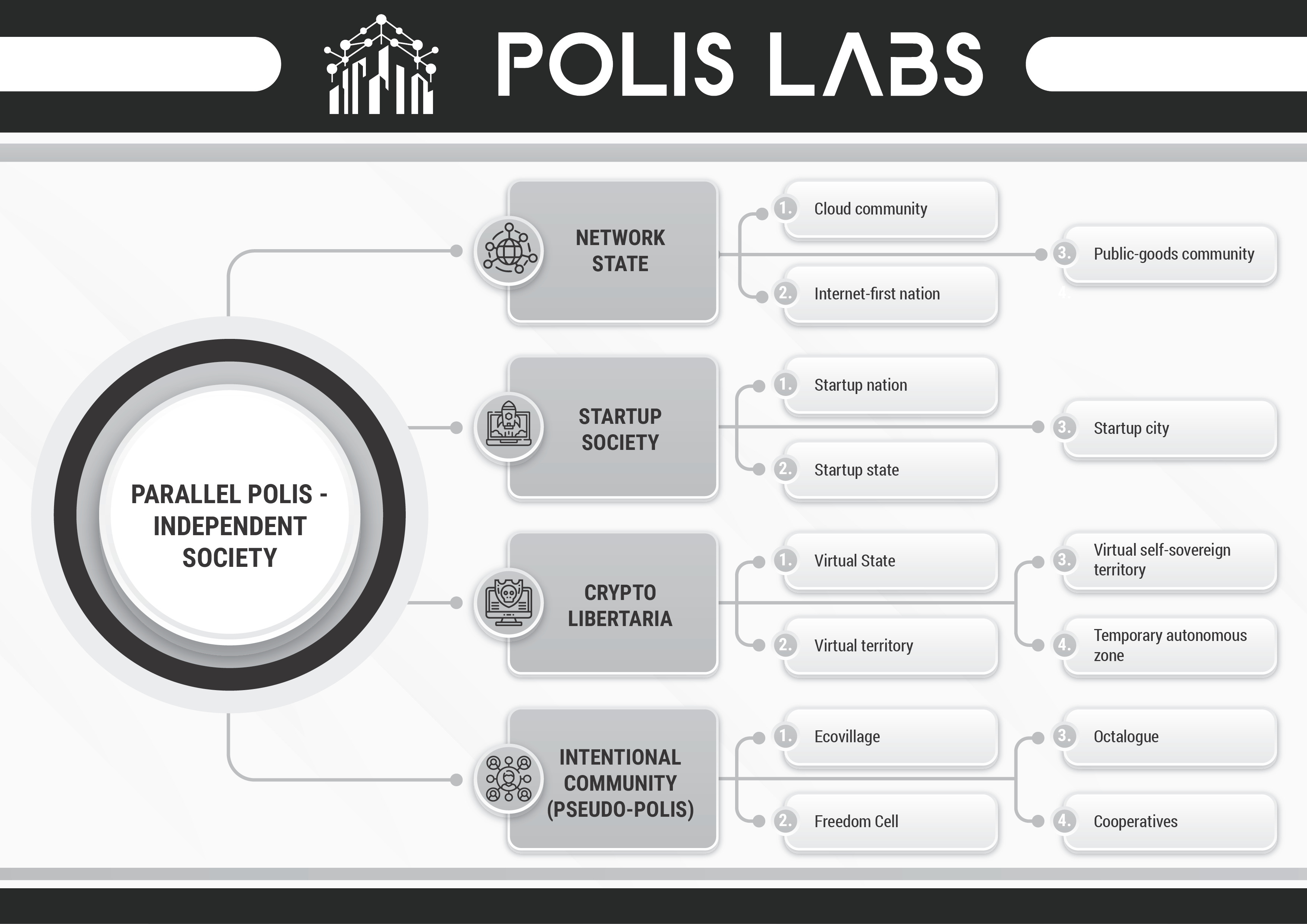
Container Reference:
Note: the reasons for container placements are not intended to be arbitrary. They are based on historical precedent and analysis of the way those who first used or coined the terms intended. However, the volume of language and distinctions makes it impossible to land on absolute clarity in defining and classifying all of the iterations. This is especially true with terms like state, nation, community, society, polity, etc.
Parallel Polis - Independent Society (meta-container)
Network State (container)
cloud community
internet-first nation (internet-first states, cities, communities, etc.)
public-goods community
Startup Society (container)
startup nation
startup state
startup city
Cyber Libertaria (container)
virtual state
virtual territory
virtual self-sovereign territory
temporary autonomous zone
Intentional Community (container) (pseudo-polis)
ecovillage
freedom cell
octalogue
cooperatives